
Written by: Charlie Murphy
Hiking makes life simple and visceral
A personal essay on multi-day hiking in Norway, physical discomfort, wilderness risk, and why hard trails make simple comforts feel vivid.
I want to understand why I love hiking so much. Especially in Norway. The kind of hike that takes multiple days and leaves me just dead tired at the end. I think it is one of the healthiest things I can do for my body and mind.
A visceral shock to my senses
As someone whose career and hobbies leave me spending a lot of time in front of a computer, I sometimes feel an almost sensory deprivation for the rest of my body. Even though I make a point to exercise and go outside every day, hiking is a whole different experience. It’s a visceral shock to my body. After hiking 10+ miles, climbing 2000+ feet, and carrying a 30+ pound pack, everything aches… but the respite feels amazing. Taking my boots off feels amazing, food and water taste incredible, warming up by a fire is deeply soothing. I feel alive. I enjoy those simple things guilt-free, knowing I made it safely to my destination for the night.
Hiking makes my reality more tangible. Staring at a screen engages just my eyes and ears, but hiking engages my whole body… it makes me feel human, both physically and mentally. Being miles into the wilderness means everything I need to worry about is right in front of me. I can touch it, smell it, and hear it. Encounter a problem? I can do something about it. Finding clean water, crossing a stream, or starting a fire. Those are my problems. But back home people talk to me through a screen about the world’s problems. Other people’s problems. Abstract problems. Problems I cannot solve and have little practical relevance to me.
Norway
Norway is my absolute favorite place to hike. I’ve made five trips there so far. The fjords are of course beautiful, but what draws me is up in the mountains. Norway is far north, so I quickly hit the tree line as I ascend. What I walk into is almost otherworldly. The lack of trees gives an unobstructed view of the vast mountains around me. I feel small. Remote. And it’s just so… quiet. All I hear is the wind and a distant stream. The cool air hitting my face lacks the normal sounds of life. No birds chirping, no flies buzzing, no people talking. I sometimes hear the distant clanking of a bell hung around a sheep’s neck (farmers let them roam freely). It’s a lonely sound. Like a distant church bell, but instead of warmly reminding me of safety and community, it’s a hollow sound in a harsh landscape.
I also love hiking in Norway because of their amazing system of cabins. All 600 or so are run by the Norwegian Trekking Association (DNT). They are spaced far enough apart that you can hike from one to the next in a day. Inside are beds, a wood stove, cooking equipment, and a pantry stocked with food. Not having to bear the weight of a tent, sleeping bag, and days’ worth of food makes the hike much more enjoyable.
Five days in the wilderness
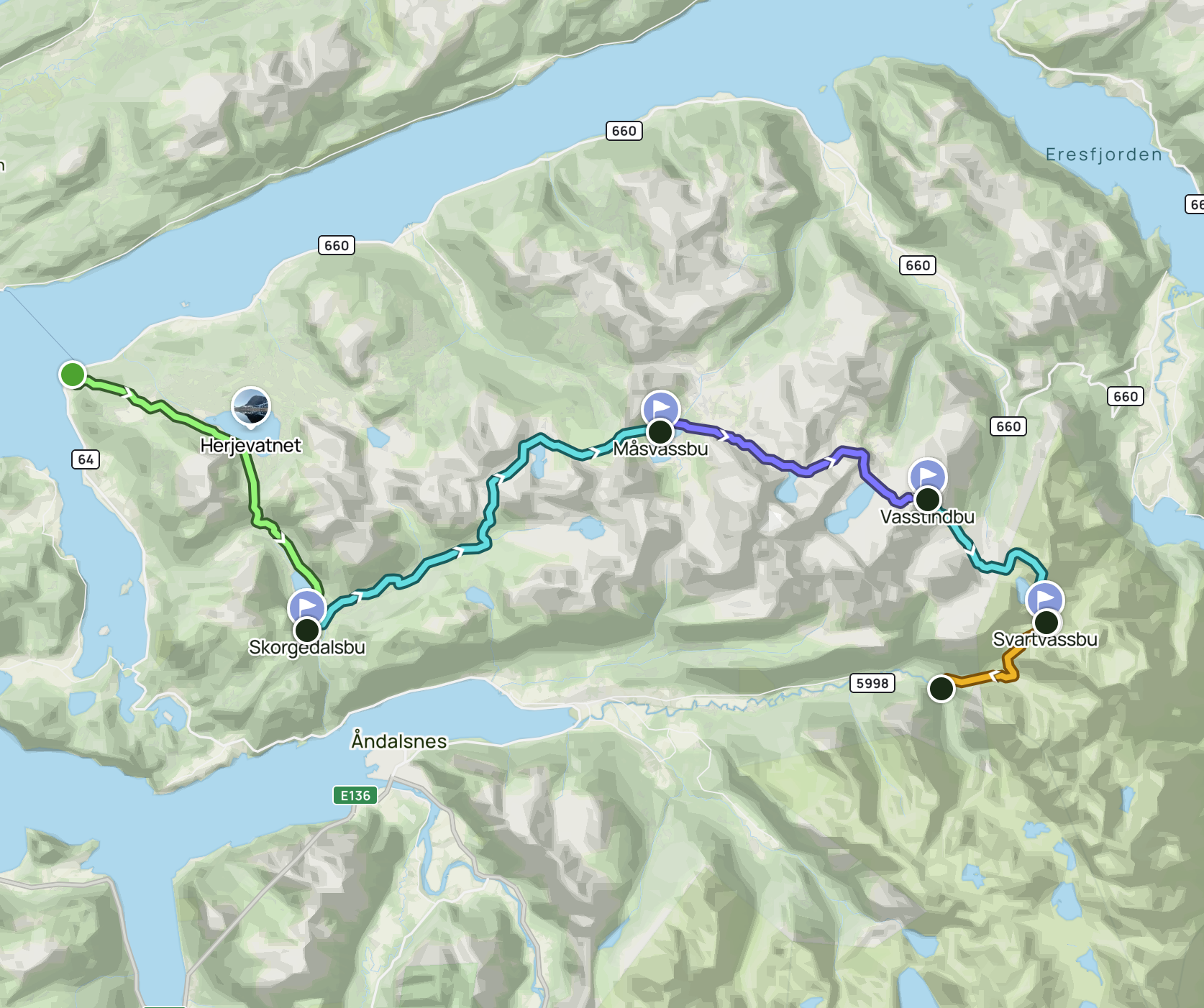
My most recent trip was on the SignaTUR Romsdalstien, a five day and 31 mile hike. One of Norway’s several signature hikes. It was a top five life experience. Five days of sun and rain. Five days of easy trails and absolutely rugged terrain. I started in a sunny fjord and ended in a sunny valley, but the time between brought me to my physical limits.
Days 1-2: Idyllic
The first couple of days were warm and sunny. I couldn’t ask for better weather. Lucky, since Norway is like the Pacific Northwest of Europe. It rains a lot. I started out in the morning from my AirBnB in the town of Molde. I had given myself a day to shake off the jet lag (6 hrs from NYC) before hitting the trail. After a bus and ferry I arrived at Åfarnes, where the trail starts. I stepped onto the trail excited, though not without some apprehension. I’ve made mistakes on hikes in Norway before. Packs that were too heavy. Weather cold and rainy enough to flirt with hypothermia. Still, I felt much better prepared this time. The first hour or two is a 1,500 ft climb up into the valley. After that it’s mostly a flat, easy walk for a few hours.
The final leg was a few hundred feet up over a mountain pass and back down into the next valley where the cabin is. I took a short break atop that pass and got probably the best view of the whole trip. With no trees to block my view, blue skies, and a warm sun, I could see for miles in every direction.
I descended back into shrubs and eventually forest, creeping past a herd of sheep who eyed me cautiously. The final half mile I had to take in ten-minute intervals; my legs didn’t want to support me anymore. I wondered if I had shaken off the jet lag yet. But there was plenty of sun still in the sky, so I didn’t rush. Besides, it never gets fully dark this time of year in Norway anyway.
I got to the cabin and I was alone. Fine with me. I explored the place, located the water source, grabbed a few food items from the pantry (paid for later by the honor system), and settled in. After a couple of hours I heard some voices outside. It was a Norwegian couple in their 20s. We chatted for a bit and learned they’re doing the same hike as me.
The second day was easier than the first. The weather is still perfect. The trail starts with a steady climb through the middle of a valley along a roaring river. The biggest challenge comes from the river crossings. Some have footbridges, others don’t. Some I can balance across on rocks, but others I just have to wade through and deal with wet boots and socks the rest of the day.
After a couple of mountain passes I get to the next cabin (Måsvassbu). A 31 bed cabin that sits on the edge of a lake surrounded by sheer, rugged mountains. I was tired. All I can do is sit on the front porch and watch as fog rolls across the lake. I still remember how good it felt to take off my boots. After a while, I was greeted by the cabin’s friendly attendant, a Norwegian woman who volunteers for DNT. She tells me about the area, the weather, and gives me a tour of the cabin.
Days 3-4: Treacherous
The third and fourth days were the hardest. For breakfast the cabin attendant offered me some of the extra oatmeal she made. She questioned if I really intended to go onto the next cabin since the weather would worsen and visibility would be poor. The next cabin (Vasstindbu) sits atop a mountain and has stunning views. The day was already chilly, overcast, and starting to rain… I didn’t think much of it at the time, so I pressed on. The hike involves a mountain pass, boulder fields, and final steep climb up to the cabin. A total of 3,000 feet of elevation gain.
Boulder fields are the worst. At one point I slip and scrape my hand and knee. My 30 pound backpack tries to push me head first down into the rocks. I had a vivid image flash in my mind of getting stuck between boulders, pinned beneath my heavy backpack while the cold rain slowly crept into me. This was probably the worst moment of the trip. I had satellite SOS devices, but what if I got pinned down? What if I hit my head on a rock?
All I can do is continue on. The rest of the day is a blur. The final leg of the hike is a steep climb up to the top of a mountain where the cabin is. There are points where I have to use my hands to pull myself up, afraid my heavy pack might pull me backward down the mountain. When I finally got to the top, I am exhausted, cold, and wet. I trudge past patches of snow, even though it’s July. At least the terrain is flattening out. I know I am getting close to the cabin, but the fog makes it hard to see. As I work my way through the rocky landscape, I suddenly smell wood smoke. I look to my left and see a cabin through the fog, smoke coming out of its chimney. I finally made it. That smell of smoke will forever be burned into my memory.
As I approach, I hear a voice call out to me. I realize there is another cabin to my right. It’s my hiking buddy from the first day and he’s standing in its doorway. He yells over that he already started the wood stove for me in the cabin I’ll be sleeping in. I walk closer to thank him. We chat for a while and agree that the day’s hike was pretty treacherous. After thanking him again I settle in for the night. The cabin is warm… too warm. I wake up in the middle of the night sweating and open the front door to let some heat out. While it cools off I walk over to the outhouse and am greeted by a pile of moss and you-know-what that stops a few inches below the toilet seat. There’s a bucket of moss nearby, I assume that’s what it’s for. I just laugh to myself. I am too tired to care. Too cold. Too bemused by the absurd thing I found on top of this cold, dark mountain.
The fourth day is much the same. A blur of fog, cold, boulders, and the unforgiving rain. It starts with a steep descent off the mountain, and ends with going up another. The trail is not well marked. I spend hours picking my way through boulder fields. Boulders the size of cars. Boulders that make me feel trapped. I want to go fast to stay warm, but I have to go slow to avoid slipping. I run out of water, so I drink straight from puddles of rain collecting on the bare rock. The water has flecks of moss, but this high up it should be clean. I am too cold and thirsty to bother filtering it. I stopped taking photos long ago. I didn’t care anymore. I am too preoccupied with my safety and staving off anxiety. I want to be off these mountains.
I finally managed to get to the next cabin. With my cold and stiff hands I start the wood stove and unintentionally fall asleep sitting in the chair as I wait to warm up. I was woken up a couple hours later by a family with a couple teenagers. They told me they rented the whole cabin, and I am supposed to be at the one five minutes up the trail. I tamped down the resentment that wanted to grow in me and make friendly conversation while I pack my stuff. They came from the direction I was heading and admit the day was much harder than they expected. They plan to continue on to the cabin I had just left, but I warn them about the terrain and weather. Norwegians are an outdoorsy people, though, so I assume they carried on.
Eventually, I trudge back out into the cold. One kid yells thank you to me as I head off to the next cabin. It’s a two-roomed building with 6 beds that’s already warm and cozy. I am greeted by the same friendly couple I met on the first day. There is also a middle aged lady there on her own. She has zero friendliness in her eyes as she looks at me, so we don’t exchange any words. But that’s fine. I can show friendliness not by words, but by giving her space.
Day 5: Relief
The final day was like the first. Idyllic. After waking up and saying goodbye to my cabin mates, I set out for a day that was almost all downhill; about 2000 feet of descent. Sounds easy, but many hikers will say downhill can be harder than uphill. Strangely, I didn’t have breakfast. I just wasn’t hungry. I barely ate the previous day too. Maybe all the dried food messed with my appetite. Or maybe my body just shifted into survival mode. I am not sure.
I walked down out of the mountains, away from the rain, cold, fog, and godforsaken boulders, leaving the raw edge of the wilderness behind me. I stepped out of the forest and into a warm and sunny valley. I was on a gravel road surrounded by farms. Peaceful. Quiet. I feel myself finally relax. To go from days of cold, rain, and exhaustion to that kind of warmth and stillness… is like stepping into a different world.
The trail ended, but I wasn’t done. It was a 2 mile walk to the nearest town. I don’t mind, though. It was an easy gravel road the entire way. Made easier when, halfway along, two guys visiting the area from Oslo offered me a ride. After days in the unforgiving wilderness, their kindness was refreshing.
A car ride and a short bus ride later, I get to my hotel in Åndalsnes. The next couple days are for recovery. It hurt to bend my legs. The bottom of my feet were numb. I limped along. I had cuts on my hand and knee that were starting to fester since I couldn’t keep them clean. My clothes were dirty. Boots muddy. I smelled… but I took care of all of that. And two days later, I felt normal again.
Why do I hike?
Now, many months after my last trip to Norway, I wonder about this. The views stunned my eyes. The trail beat down my body. The boulders and rain harrowed my psyche. The discomfort isn’t just a tolerated trade off, it’s the point. It makes the simple things feel extraordinary. After a day like that, food, warmth, and a place to sleep are all I need, all I want.
But why put myself through the risk? For even the most experienced trekkers, all it takes is one mistake. Back home, comfort and safety are the default. But out there, they have to be earned. I ask myself these things while climbing, cold and exhausted. In those moments I swear I won’t come back. But weeks, months later I can’t wait to return.